Shanghai morning


beadandjoy hand made products
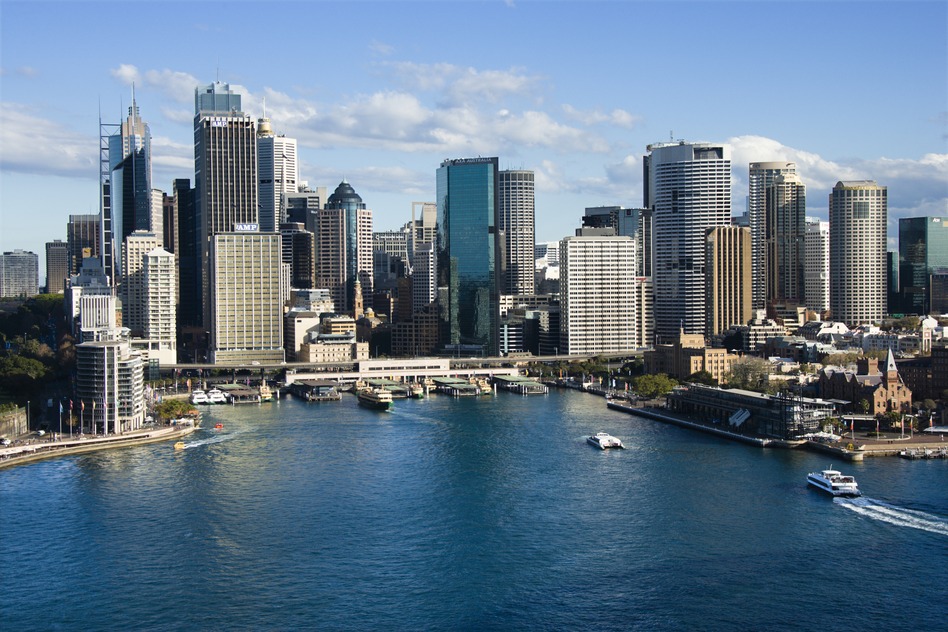
Aerial view of skyscrapers and Sydney Cove in Sydney, Australia.
Sydney Cove was named after the British Home Secretary, Thomas Townshend, Lord Sydney. It was the site chosen by Captain Arthur Phillip between 21 and 23 January 1788 for the British penal settlement which is now the city of Sydney, and where possession of New South Wales was formally declared on 26 January (now commemorated as Australia Day). Today, the exact site where the flag was planted is not apparent, as in its place is Circular Quay and Buildings of Sydney CBD. Phillip's instructions were to establish the settlement at Botany Bay, a large bay (further south of Sydney Cove) down the coast. Botany Bay had been discovered by Lieutenant James Cook during his voyage of discovery in 1770, and was recommended by the eminent botanist Sir Joseph Banks, who had accompanied Cook, as a suitable site for a settlement. But Phillip discovered that Botany Bay offered neither a secure anchorage nor a reliable source of fresh water. Sydney Cove offered both of these, being serviced by a fresh water creek which was soon to be known as Tank Stream.
Today the Tank Stream is encased in a concrete drain beneath the streets of the central business district and all native bushland has been cleared. The head of the cove is occupied by the Circular Quay ferry terminal. On Bennelong Point at the northern end of the eastern shore of the cove stands the Sydney Opera House. On the western shore is the historic district known as The Rocks.

Young tourist kneeling on the rooftop of a skyscraper over a big city.
A skyscraper is a tall, continuously habitable building of many storeys, usually designed for office and commercial use. There is no official definition or height above which a building may be classified as a skyscraper. One common feature of skyscrapers is having a steel framework that supports curtain walls. These curtain walls either bear on the framework below or are possibly suspended from the framework above, rather than load-bearing walls of conventional construction.
Some early skyscrapers have a steel frame that enables the construction of load-bearing walls taller than of those made of reinforced concrete. Modern skyscrapers' walls are not load-bearing, and most skyscrapers are characterized by large surface areas of windows made possible by the concept of steel frame and curtain walls. However, skyscrapers can have curtain walls that mimic conventional walls and a small surface area of windows.